Lay-lah Lay-lah (Night Night, לַיְלָה לַיְלָה)
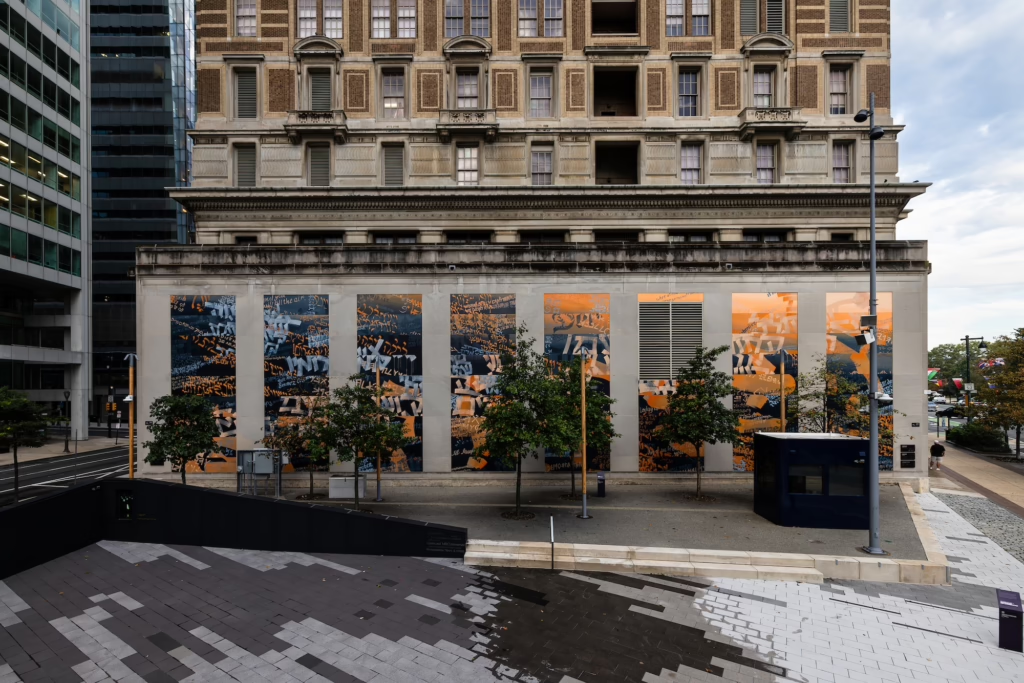
The mural explores what has been passed down and remembered and what has been lost to tragedy, time, and social change. It reflects on individual and collective memory, examining how memory is formed, erased, and overwritten.
The mural’s creation process and resulting style reflect its central themes of displacement and cultural resilience. Using a method of writing, fragmenting, shifting, and overwriting, the public’s contributions are depicted in 28 languages set in 17 scripts, reflecting the city’s layered linguistic landscape. The work examines fragmented cultural identities and their hybridity, tracing how languages and memories intersect, overlap, and transform within a shared space.
Artist Statement:
Lay-lah Lay-lah
(Night Night, לַיְלָה לַיְלָה)
Ella Ponizovsky Bergelson
The Holocaust is often viewed as a closed chapter. This mural approaches this history as an evolving force that is still unfolding. The mural centers on the forced displacement that was triggered during that dark time. What was set in motion then continues to shape the present, reverberating through generations and continents, and echoing through identities and cultures. The mural holds space for the displaced and for their experiences of erasure and survival, shattering and repair.
Every line of text in this mural was contributed by individuals from across Philadelphia, collected through a citywide call for memories. Participants shared lullabies, poems, and prayers from their childhoods—verses and melodies that act as building blocks of family heritage, folk narrative, and cultural memory. These contributions, depicted here in 28 languages set in 17 scripts, root the mural in lived experiences, making it an expression of collective remembrance and a reflection of Philadelphia. Just as individual memory is fluid and subjective, so is collective memory ever-evolving, reshaped by the narratives and silences of its time and place. Layered and partially concealed, the texts mirror how memory itself is passed on, bearing both the preserved and the lost. The mural asks: What is visible and what is obscured? What is remembered and carried forward, and what is lost to tragedy and time? How do memories shape the present and future?
The creation process reflects the mural’s central themes of uprooting and cultural resilience. Using a custom-developed method of writing, fragmenting, shifting, and overwriting, the composition juxtaposes eras, languages, and perspectives in a visual polyphony. Verses are overlaid, creating a space where identities are fractured and reassembled—always diverse, multifaceted, and forever in motion.
This mural stands here to honor the millions of victims of the Nazi genocide and the survivors who resettled in the Philadelphia region, whose legacy continues through this work. It is placed in direct conversation with Philadelphia’s civic promise, echoing its heritage as a sanctuary of tolerance and diversity. It is a reminder that the survival of cultures against all odds is a form of resistance, that liberty begins with the right to be different, and that Holocaust remembrance is, at its core, a commitment to harmonious coexistence.
Learn more about the project at the Philadelphia Holocaust Remembrance Foundation website