Making of a Mural: Zoo Menagerie

For more than two decades, Mural Arts’ Restoration program has kept this beloved zoo landmark growing alongside the city. Explore the evolution of a Philadelphia mural, 2002-2026.
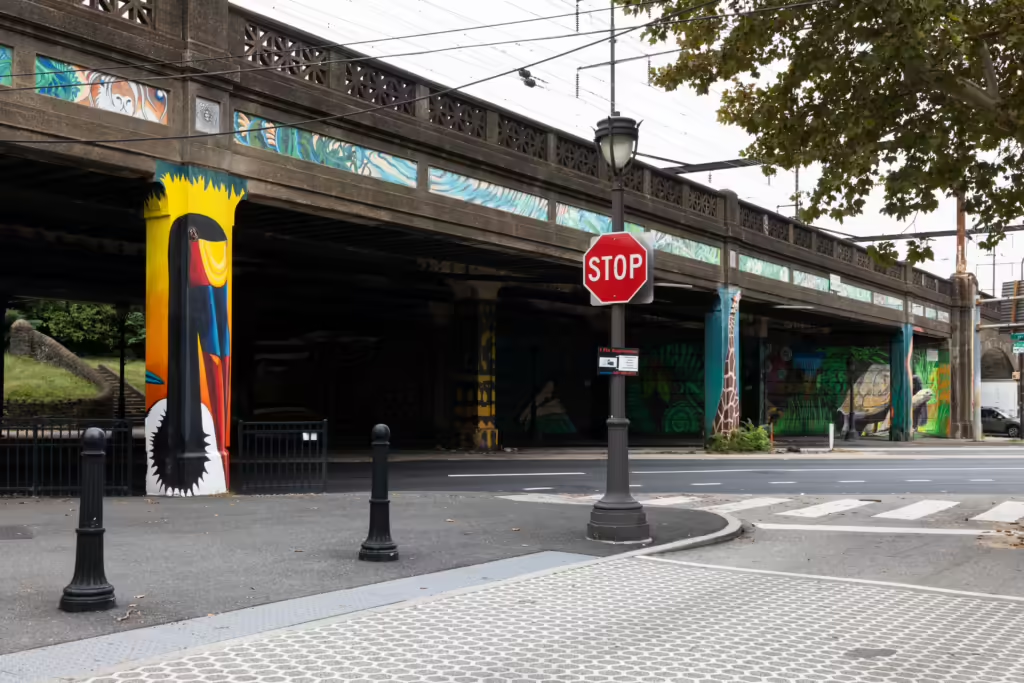
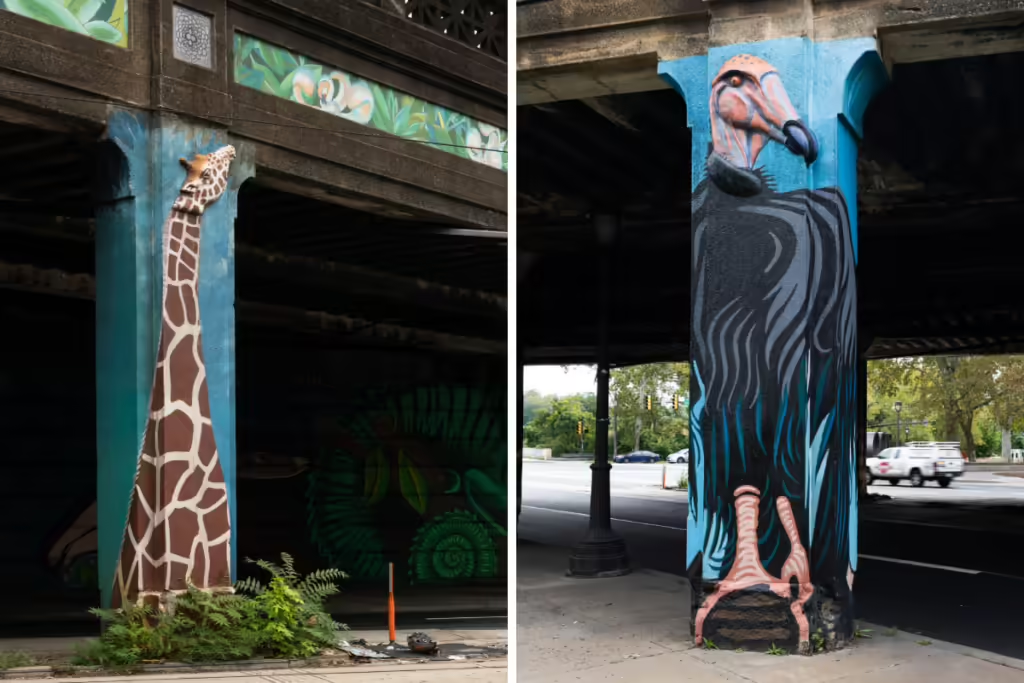
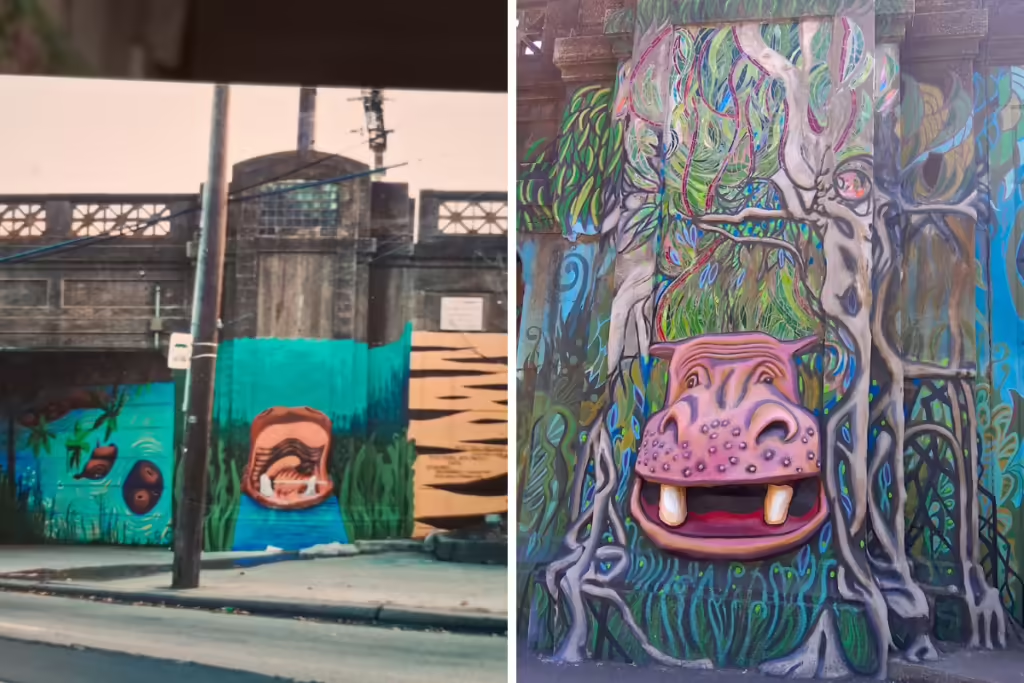
Many Philadelphians who grew up going to the Philadelphia Zoo remember the animals hiding under the underpass. Maybe you stuck your head into the hippo’s mouth, craned your neck to follow the giraffe up a bridge column, or tested your bravery in front of the anaconda.
Zoo Menagerie, first painted in 2002, brought the wild world of nature into public space—and remains a fixture of Mural Arts Philadelphia’s collection through the work of its Restorations initiative.
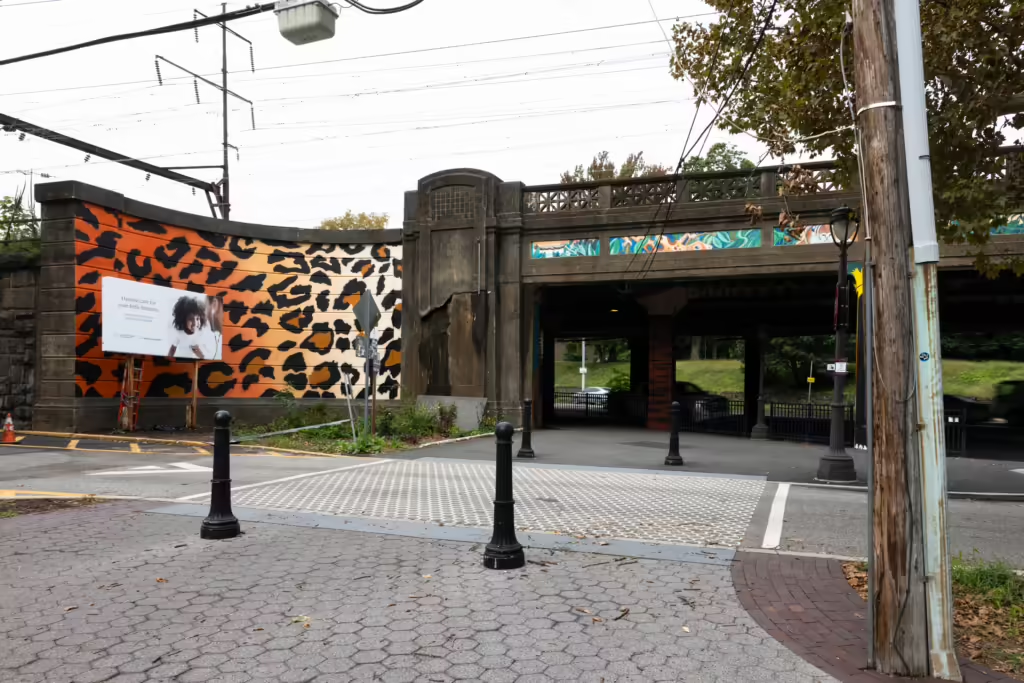
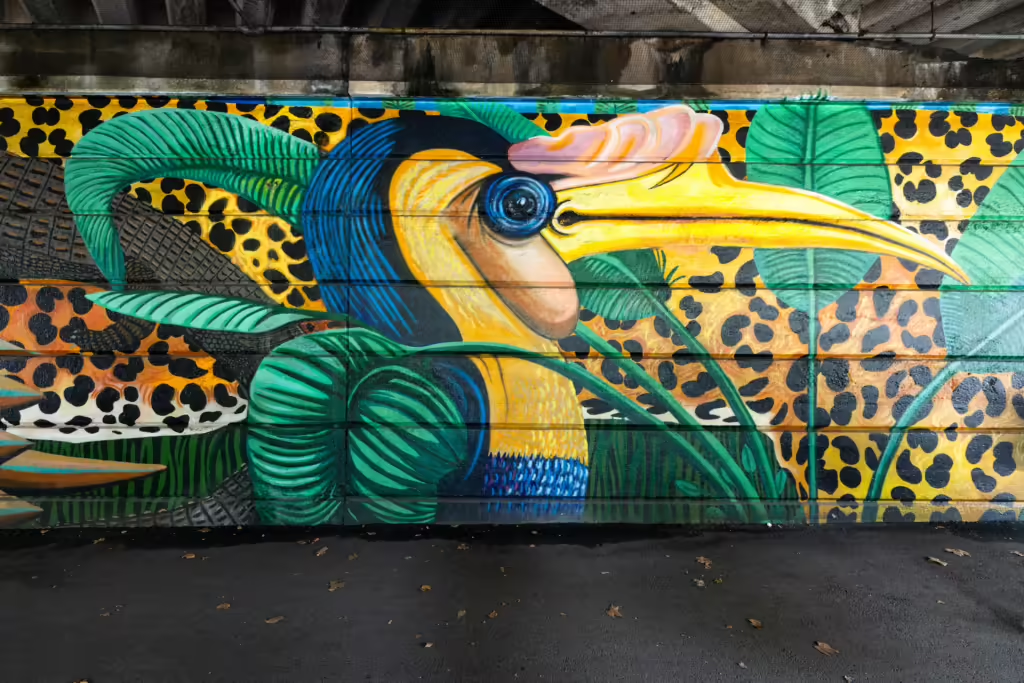
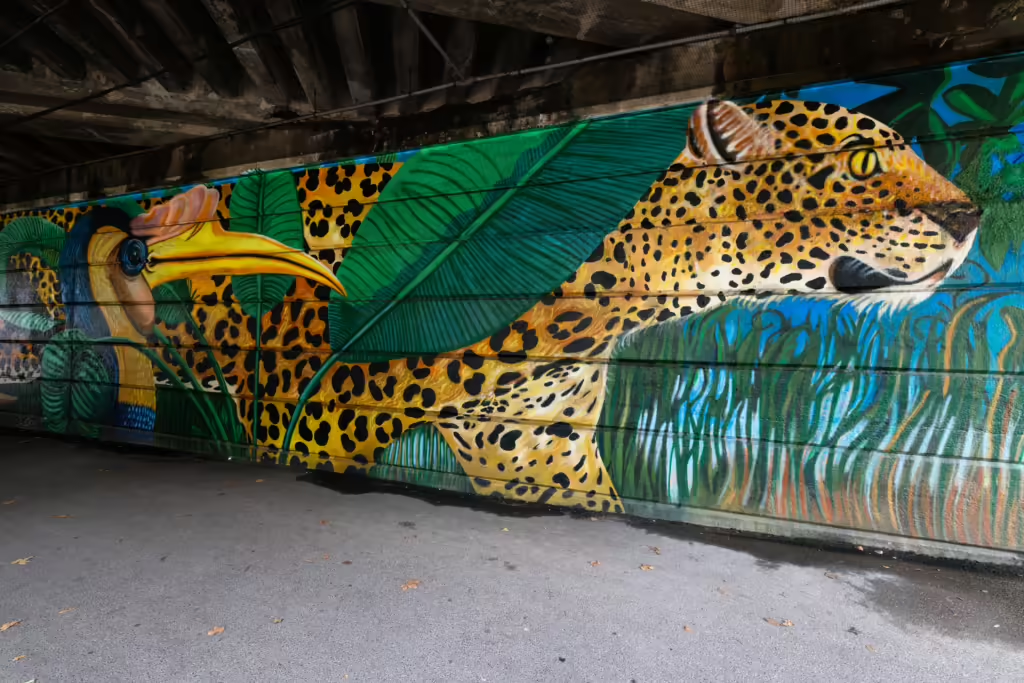
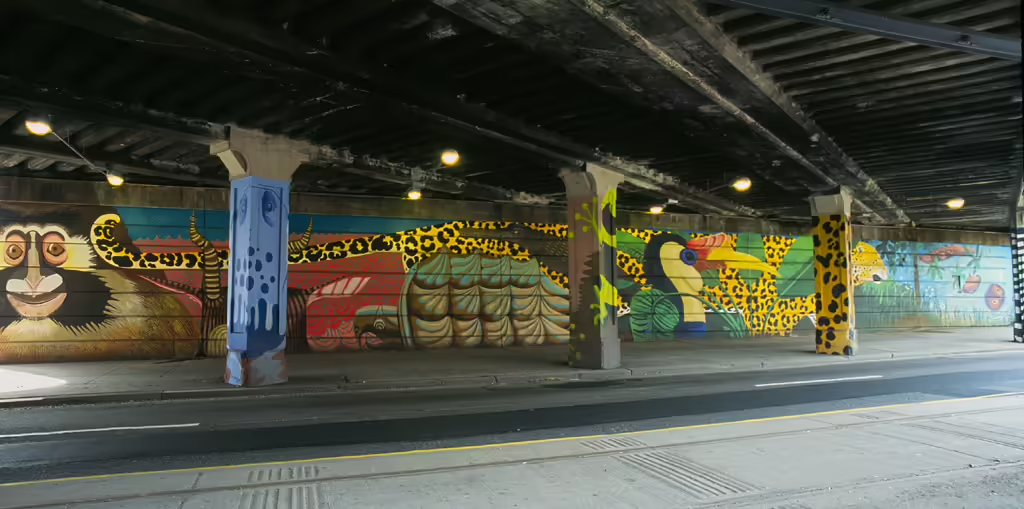
For muralist Paul Santoleri, the artist behind the original design, the work has never been quite finished. Santoleri returned to help restore the mural in 2011, 2022, and most recently, in 2026, repairing the effects of weather and time while adapting the artwork to its surroundings. This latest restoration brought the mural its first new imagery since its creation: leopard spots refreshed the zebra wall, and the Galapagos tortoise replaced an elephant.
“It’s an honor that they want to keep it up and keep it alive and keep it going,” Santoleri said. “I feel like it holds a special place in a lot of people’s hearts. Generation after generation, because of my love for animals, I feel like it’s really an extension of myself.”
More than two decades after its debut, Zoo Menagerie is still changing. Its story is also a reminder that preserving public art doesn’t mean freezing it in time—sometimes keeping a mural alive means giving it room to grow.
How Zoo Menagerie came to life
Santoleri began working with Mural Arts Philadelphia in 1997, and by 2002 he had created several large-scale murals in the city, including Passion Flower in West Powelton and Philadelphia on a Half-Tank—once a one of the first images to greet travelers from Philadelphia International Airport.
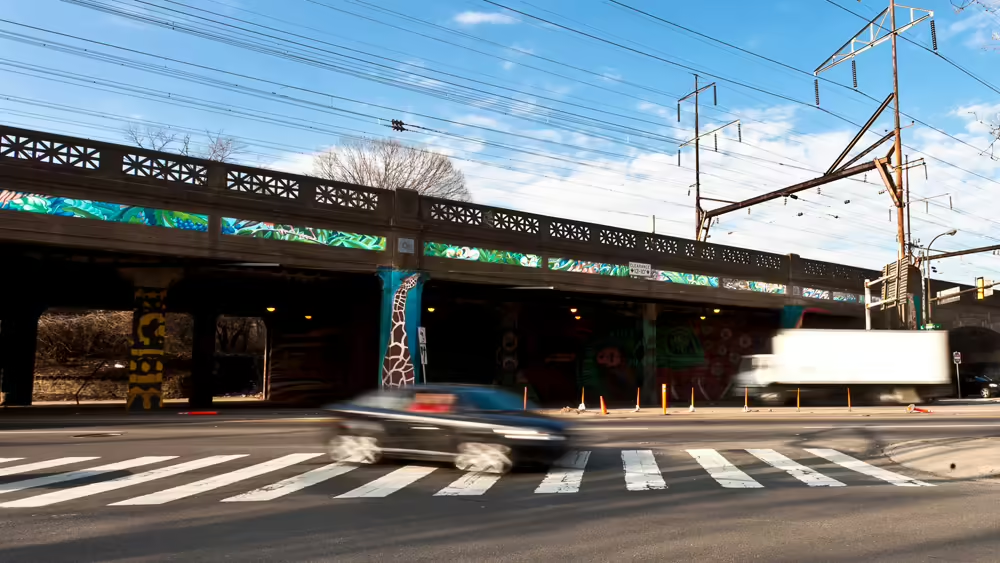
But even for an experienced muralist, Zoo Menagarie was a unique challenge. Located under a poorly lit bridge, on a wall rife with holes and cracks, the mural was meant to transport zoo visitors to another world from the dingy Girard Avenue bridge.
From the start, Santoleri designed the mural to be responsive to the world around it. He began by visiting the zoo and drawing the animals from life, or as he describes it, “working from their collection.”
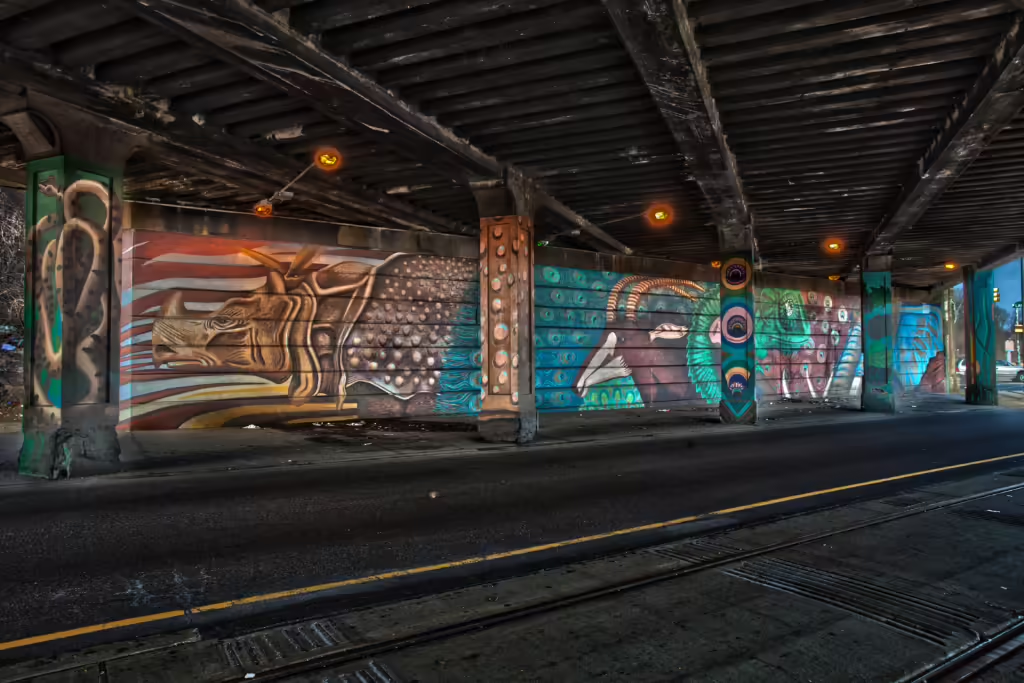
When a visitor called the zoo’s southern white rhinoceros ugly, Santoleri vowed to make it one of the first animals that people saw in the mural. The anaconda was a clear favorite with kids, so it also made the cut. He envisioned the mural—with the Andean condor on one end and the giraffe on the other—as an underground passageway, bookended by a pair of welcoming and departing animals.
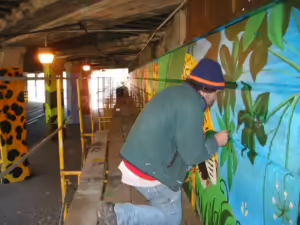
Painting directly on the wall, Santoleri would arrive early each morning to refresh his view of the animals next door. He remembers being greeted by the giraffe and monkeys, eager to see their first visitor of the day.
“I was amazed at how the animals would kind of run to you as you came in. I thought it was really cool that a giraffe would run over and say, ‘Hey what’s going on?’ I had an interesting relationship with the monkeys, kind of like an extended family.”
An avid nature lover, Santoleri’s art practice was influenced by his gardener parents, who harvested produce in their backyard. As an adult, he drew inspiration from the healing power of nature that could be found throughout the city—from Philadelphia’s many trails and parks, to flowers growing through the concrete.
So when Mural Arts Founder Jane Golden approached him to make a mural featuring 18-foot-tall animals, Santoleri knew immediately it was a perfect fit.
“I was never drawn to making people large. It was never my desire to aggrandize people—I felt like we were big enough, that nature had a [bigger role to] play in my environmental and climate concerns,” he said. “I spent a lot of time in different parts of the country where I was overwhelmed by the magic and bigness of it all, and my place in it, where I felt tiny, and I kind of wanted that to be my legacy.”
That sense of scale extended to the city itself, Santoleri said: “Even when I did the big mural of the city, [Philadelphia on a Half-Tank], I felt like the city was this moving organism—an object that is nature in and of itself. These big animals are like that too.”

What it takes to maintain a mural
Outdoor public art is inevitably subject to the passage of time. Sun exposure, weather, and the deterioration of the walls beneath a mural can all affect its appearance and structure. According to Mural Arts Restorations and Operations Manager Isaac Faller, murals have a shelf life of around 20 years before they begin to need more substantial repairs.
For Mural Arts, restorations are a way to upkeep the city’s collection of 4,000 public murals—more than 300 of which are 20+ years old. The organization undertakes about 15 full restoration projects per year, prioritized by factors such as the mural’s condition, historical significance, and public demand.
The work can range from handwashing and small paint touch-ups to large-scale repairs and entire re-dos. For a full restoration, Mural Arts works with the original artist or experienced restoration artists to bring the mural back to life. The restoration teams use reference photographs to match the original colors, restore depth and gradients that have faded over time, and finish with a protective acrylic sealer.
“Restorations are an art in and of themselves,” said Jenn Procacci, who helped restore Zoo Menagerie in 2011, 2022, and 2026. “You’re working on a piece of art that the community already has a relationship with, and that generates a lot of dialogue between us and community members… It’s always great to hear about folks’ connections with the work and the stories they share with us, and of course they are always happy and excited when they learn that we are fixing up and repairing the art.”
But restoration isn’t always about returning a mural to exactly how it looked on day one. The artists also consider how the artwork interacts with its surroundings, responding to weather patterns, traffic, development, and community input.
For example, during the 2011 restoration of Zoo Menagerie, Santoleri realized that part of the wall was continually saturated with water, mud, and salt from the bridge above. Rather than simply repainting the affected area, he adapted the design to make it more sustainable. Three-dimensional tree branches now channel runoff to cascade around the hippo, letting him frolic in his own personal mud pile.
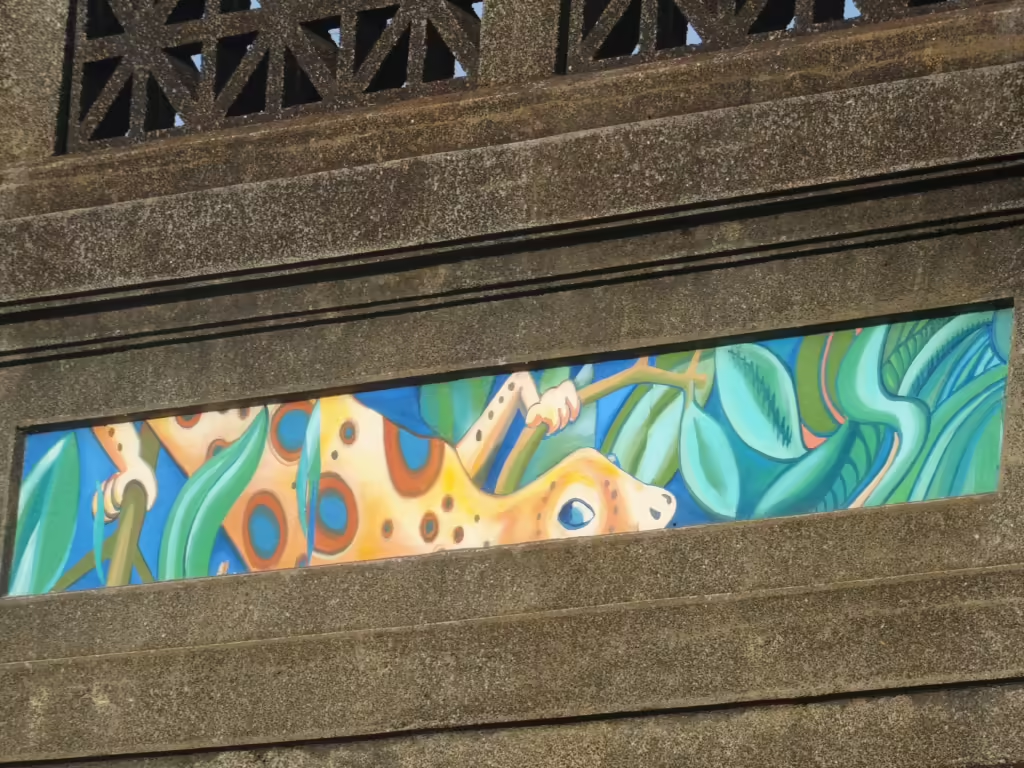
Every restoration adds a new dimension. At some point Santoleri decided to close the hippo’s mouth somewhat, creating its signature toothy smile—and one of the mural’s most beloved elements. “I felt like he just wanted to change it,” the artist said. In 2011, the team added painted framed inserts to the bridge over Girard Avenue, bringing even more animals into the fold. “It became much more complex and cool. It just kept growing and changing,” Santoleri said.

A new generation of Zoo Menagerie
In summer 2026, Santoleri returned to restore the mural alongside a team of Restoration artists: Diana Gonzalez, Lami Tolla, Adriana Amador-Chacon, Jenn Procacci, and Gene Barclay.
As one of the city’s most-frequently restored murals, Zoo Menagerie is familiar territory for restoration artists, functioning like a giant paint-by-numbers. “The goal is to have the repairs you make blend seamlessly into the rest of the work,” said Procacci. “It takes a special touch to mix the colors in the right way, so that the new paint is dulled down just the right amount to blend in with the original paint.”
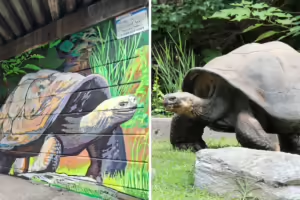
This year’s restoration held particular significance. For the first time since the mural’s creation, Santoleri introduced new, original imagery: The zebra-patterned wall became a leopard-print wall—chosen for its brighter, more vibrant colors—while the elephant was replaced with a Galápagos tortoise, reflecting the Philadelphia Zoo’s changing animal population.
The decision to swap out the animals brought the mural into conversation with the zoo as it exists today: Since the elephant habitat closed in 2009, the well-deserved spotlight went to the critically endangered Western Santa Cruz Galapagos tortoise, Mommy, a 100-year-old mom of 16, whose latest offspring hatched in 2025 to great fanfare.
“The mural really helps to set the tone for our guest experience,” said Dr. Jo-Elle Mogerman, President and CEO of Philadelphia Zoo. “It is so rich and vibrant, just like our animals.”
The new imagery also gave Santoleri a chance to share one of his most beloved works with his own children. “When I was asked to add on over the elephants, my sons had been really [obsessed with tortoises and] turtles. As a testament to that, and because the Galapagos tortoises just had a baby, I was like, ‘Oh, this is the perfect timing to kind of bring that into the modern part of the mural.’”
“My kids were thrilled to see a ginormous tortoise,” he added. “I did it right here in the house. I laid it out on the driveway to see how it would line up. It’s kind of cool to bring that home.”
Santoleri said he’s been able to trace the evolution of Philly’s artist community as his restoration team changes over the years, with assistants developing their own art and teaching practices—another outgrowth of mural restoration.
After getting her start as Santoleri’s assistant, Procacci has gone on to collaborate on many Mural Arts projects, including 52 Weeks of Firsts—but says Zoo Menagerie remains a throughline in her art career. Recalling her first restoration in 2011, she fondly remembers the characters she met on the street, the 75 cent pretzels she’d buy on lunch breaks, and the onlookers’ excitement at seeing the hippo get a fresh coat of paint.
“The Zoo attracts such a melting pot of demographics and communities,” she said. “It felt like such a slice of Philly.”
In the years since, restoring Zoo Menagerie has become a rite of passage. “Once we are done with the restoration, we sign our names in paint next to the hippo and put the year. It feels like our little yearbook over there at this point with all the restoration work we have done on the Zoo, and with how many people have been involved over the years,” Procacci said.
The paint may fade, the artists may change, the animals may come and go, but for the generations of visitors who encounter Zoo Menagerie on their way to the zoo, the mural remains an invitation to look a little closer at the world around them.